
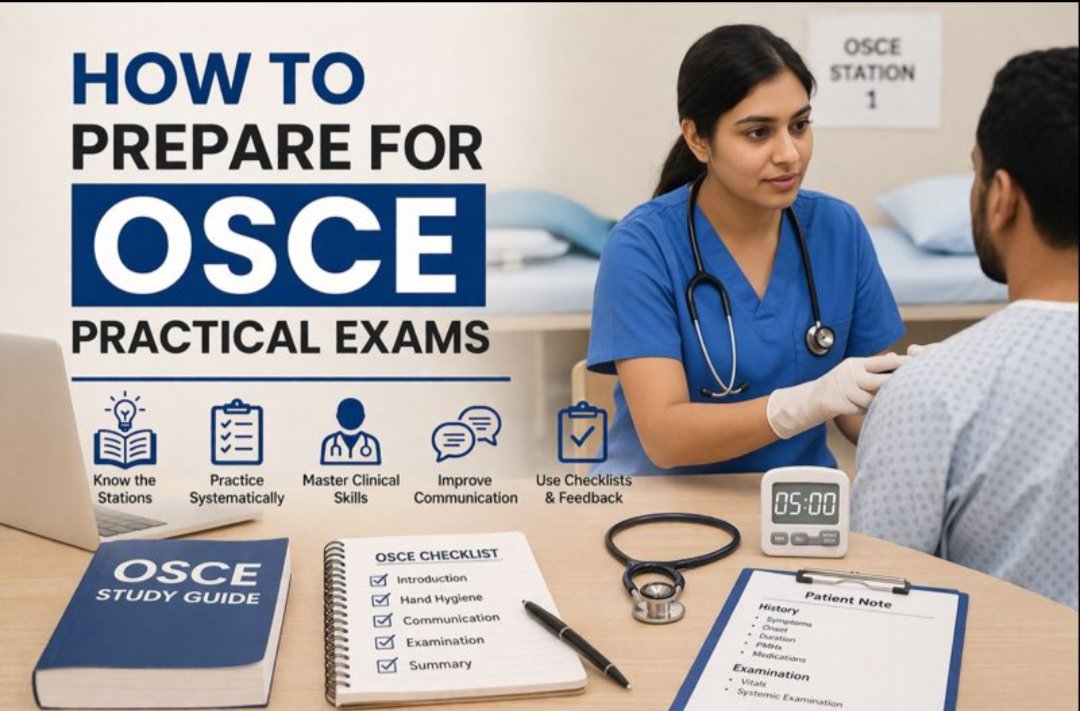
How to Prepare for OSCE Practical Exams

Meta Description :
Learn how to prepare for OSCE exams with expert tips, step-by-step strategies, and practical guidance to boost confidence and score high.
Objective Structured Clinical Examination (OSCE) is one of the most important and often stressful assessments in nursing education. Unlike written exams, OSCE tests your clinical skills, communication, critical thinking, and confidence in real-life scenarios.
Many nursing students feel anxious before OSCEs—but the truth is, with the right strategy, practice, and mindset, you can perform confidently and score high.
In this comprehensive guide, you’ll learn step-by-step preparation techniques, expert tips, common mistakes to avoid, and proven strategies to succeed in your OSCE practical exams.
📌 What Is an OSCE Exam?
An OSCE (Objective Structured Clinical Examination) is a practical exam where students rotate through different stations to demonstrate clinical skills.
Each station is designed to assess specific competencies such as:
Patient assessment
Communication skills
Clinical procedures
Decision-making
Documentation
You are evaluated using a structured checklist, ensuring fairness and standardization.
🎯 Why OSCE Exams Are Important
OSCE exams are not just tests—they prepare you for real clinical practice.
They help you:
Build clinical confidence
Improve patient interaction
Develop critical thinking
Apply theoretical knowledge in real scenarios
In short, OSCE bridges the gap between classroom learning and real patient care.

🧠 Understanding the OSCE Format
Before preparing, it’s essential to understand how OSCE exams work.
🔄 Common OSCE Structure:
Multiple stations (5–15 stations)
Time per station: 5–10 minutes
Each station has a specific task
Examiner observes silently or interacts
📝 Types of Stations:
Procedure-based (e.g., IV insertion)
Communication (e.g., patient counseling)
Assessment (e.g., vital signs)
Interpretation (e.g., ECG reading)
Knowing the format reduces anxiety and improves performance.
📚 Step-by-Step OSCE Preparation Plan
1. Start Early and Plan Smart
Avoid last-minute cramming. Create a study schedule that includes:
Daily skill practice
Revision sessions
Mock OSCE practice
Consistency is key to mastering clinical skills.
2. Master the Basics First
Focus on fundamental nursing skills:
Hand hygiene
Vital signs measurement
Patient identification
Infection control
These are commonly tested and carry significant marks.
3. Practice Clinical Skills Repeatedly
OSCE is all about performance, not just knowledge.
Practice:
Wound dressing
Catheterization
Enema
administration
Oxygen therapy
Repetition builds muscle memory and confidence.
4. Use Checklists and Guidelines
Most OSCE exams follow structured checklists.
Practice using:
Step-by-step procedure lists
Nursing protocols
Clinical guidelines
This helps you avoid missing important steps during the exam.

🗣️ Communication Skills: The Key to High Scores
Communication is a major part of OSCE scoring.
Always Remember:
Introduce yourself
Confirm patient identity
Explain the procedure
Obtain consent
Show empathy
Good communication can significantly boost your marks—even if minor mistakes occur.
🧍 Patient Interaction Tips
Maintain eye contact
Use simple language
Be calm and confident
Respect patient dignity
Treat mannequins or actors like real patients.

⏱️ Time Management in OSCE
Time is limited, so managing it well is crucial.
Tips:
Read instructions quickly
Start immediately
Don’t panic if you forget a step
Keep an eye on time
Practice with a timer to improve speed.
🧪 Common OSCE Skills You Must Prepare
Here are high-yield skills frequently tested:
Hand hygiene technique
Vital signs assessment
IV cannulation
Medication administration
Wound care
CPR (Basic Life Support)
Oxygen therapy
Patient education
Focus on accuracy and sequence.
❌ Common Mistakes to Avoid
Many students lose marks due to simple mistakes.
Avoid:
Skipping hand hygiene
Forgetting patient identification
Poor communication
Lack of confidence
Rushing without thinking
Small details make a big difference.
🧘 Managing OSCE Exam Anxiety
Feeling nervous is normal, but don’t let anxiety affect your performance.
Tips to Stay Calm:
Practice regularlyTake deep breaths
Visualize successStay positive
Confidence comes from preparation.
🧑⚕️ Mock OSCE Practice: Your Secret Weapon
Simulated practice is one of the best ways to prepare.
Practice With:
Friends or classmates
Nursing labs
Online OSCE videos
Ask for feedback and improve continuously.

📝 Documentation Skills in OSCE
Some stations require documentation.Ensure you:
Write clearly
Use correct terminology
Record accurate data
Follow proper format
Documentation reflects professional competence.
🧩 OSCE Day Checklist
Before entering the exam:
✔ Wear proper uniform
✔ Carry required equipment
✔ Stay hydrated
✔ Reach early
✔ Stay calm and focused
🚀 Last-Minute Preparation Tips
Revise key procedures
Review checklists
Avoid learning new topics
Sleep well before exam
A fresh mind performs better.
💡 Pro Tips to Score High in OSCE
Always follow systematic approach
Speak your actions aloud (if allowed)
Maintain professionalism
Show confidence
Be patient-centered
🌟 The Role of Confidence in OSCE Success
Confidence is as important as knowledge.Even if you make a mistake:
Stay calm
Continue the procedure
Don’t panic
Examiners value safe and confident practice.
🎯 Conclusion
Preparing for OSCE practical exams may seem challenging, but with the right strategy, consistent practice, and a positive mindset, success is absolutely achievable.
Remember:
👉 Practice regularly
👉 Focus on basics
👉 Improve communication
👉 Stay calm and confident
OSCE is not just an exam—it is your stepping stone to becoming a competent and confident nurse.
❓ Frequently Asked Questions (FAQ)
🔹 What is an OSCE practical exam?
An OSCE (Objective Structured Clinical Examination) is a hands-on exam where nursing and medical students rotate through different stations to demonstrate clinical skills, communication, and decision-making in real-life scenarios.
🔹 How can I effectively prepare for OSCE exams?
Start by understanding the exam format, practice clinical skills regularly, use checklists, revise theory concepts, and perform mock OSCE stations with friends or mentors.
🔹 What are OSCE stations?
OSCE stations are timed scenarios where students perform specific tasks such as patient assessment, history taking, or procedures like injections and wound care.
🔹 How important is communication in OSCE?
Communication is extremely important. Examiners assess how clearly and professionally you interact with patients, explain procedures, and show empathy.
🔹 What should I say during an OSCE exam?
Always introduce yourself, confirm patient identity, explain the procedure, obtain consent, and maintain professional communication throughout the station.
🔹 How do I manage time during OSCE stations?
Practice with a timer, follow a structured approach, and avoid spending too much time on one step. Focus on completing all key components efficiently.
🔹 What are common mistakes in OSCE exams?
Common mistakes include forgetting hand hygiene, poor communication, missing key steps, lack of confidence, and not following a systematic approach.
🔹 Do I need to memorize everything for OSCE?
No, you don’t need to memorize everything. Focus on understanding concepts, practicing procedures, and using logical clinical reasoning.
🔹 How can I improve my confidence for OSCE?
Practice regularly, simulate real exam conditions, get feedback, and stay calm. Confidence improves with preparation and repetition.
🔹 What should I bring on OSCE exam day?
Carry your ID, necessary stationery, clinical tools (if required), and maintain a professional appearance with proper uniform and hygiene.
🔹 Is practicing with friends helpful for OSCE?
Yes, practicing with peers helps simulate real exam scenarios, improves communication skills, and builds confidence.
🔹 How do examiners mark OSCE?
Examiners use structured checklists to evaluate your performance, including clinical accuracy, communication, professionalism, and safety.