
Meta Description:
Learn how to think like an NCLEX nurse with clear priority-setting strategies, ABC framework, safety rules, and delegation tips explained in simple, practical language.

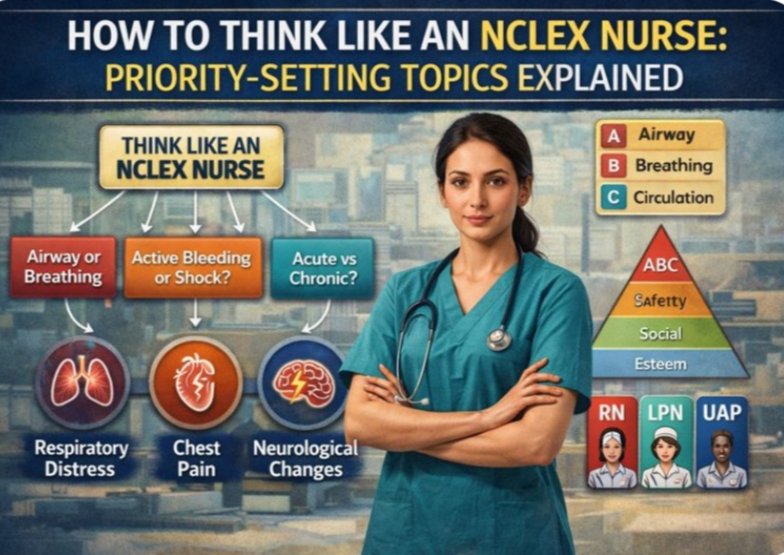
How to Think Like an NCLEX Nurse: Priority-Setting Topics Explained
Passing the NCLEX is not about memorizing thousands of facts.It’s about thinking like a nurse.Many nursing students say the same thing after failing or barely passing practice exams:“I knew the content… but I didn’t know what the question was really asking.”That’s because the NCLEX doesn’t test what you know—it tests how you prioritize, how you make decisions, and how safely you think under pressure.
In this article, you’ll learn how to think like an NCLEX nurse, with a deep focus on priority-setting, the most tested and most confusing NCLEX skill.
Why Priority-Setting Is the Heart of the NCLEX
In real nursing practice, you are never caring for just one patient.You may have:
One patient short of breath
Another complaining of pain
A third with abnormal lab results
And a fourth waiting for discharge teaching
The NCLEX asks one question:
👉 Who needs you first?
Priority-setting questions test whether you can:
Prevent death
Prevent complications
Act safely
Recognize emergencies early This is why priority questions appear in:
Medical-surgical nursing
Pediatrics
Obstetrics
Mental health
Delegation and management of care
What Does “Thinking Like an NCLEX Nurse” Mean?
Thinking like an NCLEX nurse means:
You don’t panic when a question looks long
You ignore distractions in the question
You identify what is life-threatening
You choose safety over comfort
You act, not assess, when immediate danger existsIt’s clinical reasoning—not guessing.
The Core Priority Frameworks Every NCLEX Nurse Must Master
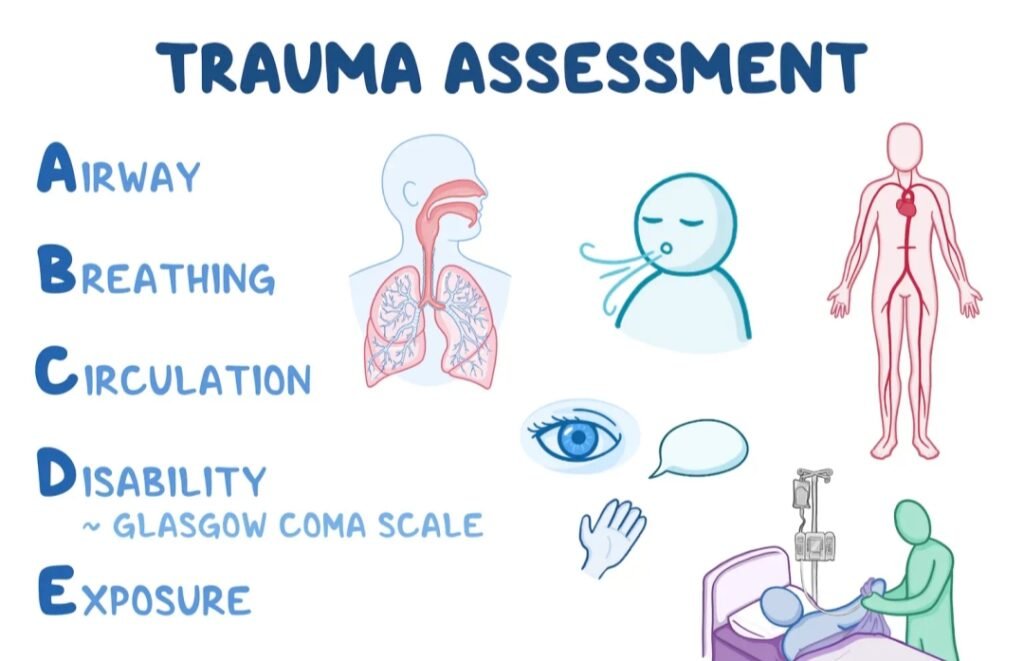
1. ABCs: Airway, Breathing, Circulation
This is the gold standard of priority-setting.Always ask yourself:“Which option affects airway, breathing, or circulation?”
Airway always comes first
Breathing second
Circulation third
Example:Which patient should the nurse see first?
A patient with chest pain
A patient with oxygen saturation of 88%
A patient with abdominal pain
A patient waiting for discharge instructions
✅ Correct priority: Oxygen saturation of 88% (Breathing)
2. Actual vs. Potential Problems
Actual problems > Potential problemsNCLEX loves to test this.Example:
Risk for infection
Active bleeding
Risk for falls
Risk for impaired skin integrity
✅ Correct priority: Active bleeding (actual problem)
3. Acute vs. Chronic Conditions
Acute (new, sudden, worsening) > Chronic (long-term, stable)Example:
A diabetic with controlled blood sugar
A COPD patient with sudden shortness of breath
A hypertensive patient on medication
A patient with chronic back pain
✅ Correct priority: COPD patient with sudden SOB
4. Safety First—Always
NCLEX is obsessed with patient safety.If an option prevents:
Aspiration
Falls
Medication errors
Injury Death
👉 That option moves to the top.
Example:
Administer pain medication
Assist patient to bathroom
Raise side rails on a confused patient
Provide discharge teaching
✅ Correct priority: Raise side rails (safety)
Maslow’s Hierarchy on the NCLEX
Maslow is secondary, not primary—but still important.
Order:
Physiological
SafetyLove/belongingEsteem
Self-actualization
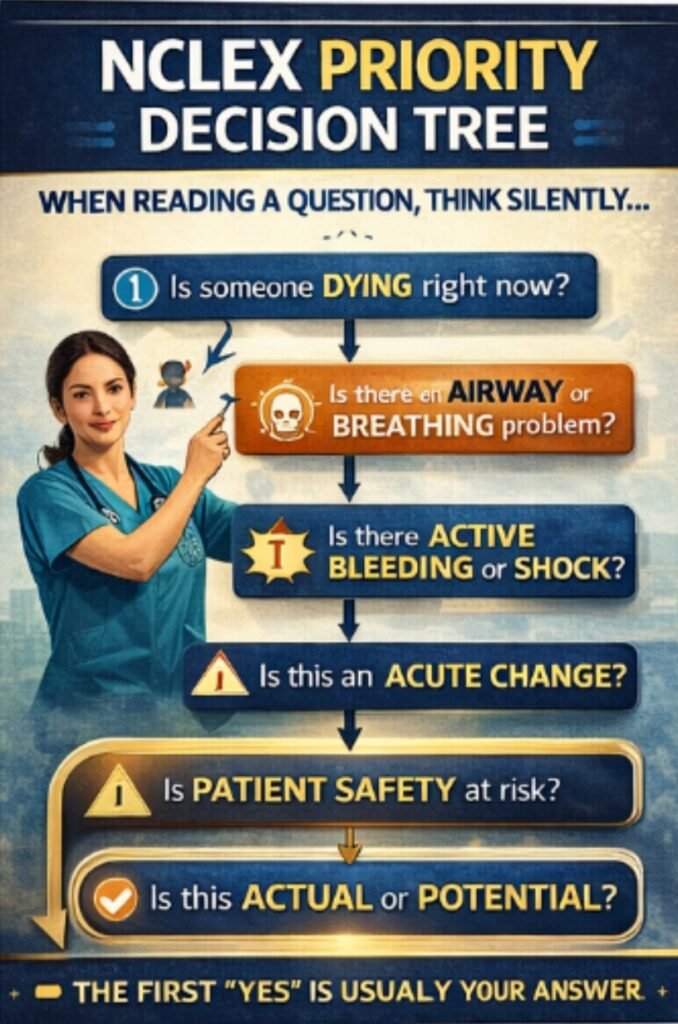
Use Maslow only after ABCs and safety.The NCLEX Priority Decision Tree (Think This Way)
When reading a question, silently ask:
Is someone dying right now?
Is there an airway or breathing problem?
Is there active bleeding or shock?
Is this an acute change?
Is patient safety at risk?
Is this actual or potential?
The first “YES” is usually your answer.
Common NCLEX Priority Topics You Must Master
1. Respiratory Distress
NCLEX red flags:
Stridor
Wheezing
Use of accessory muscles
Low oxygen saturation
Restlessness or confusion
👉 Respiratory problems always move up the list.
2. Chest Pain and Cardiac Issues
Chest pain = emergency until proven otherwise.Priority signs:
Crushing chest pain
Radiating pain
Diaphoresis
Hypotension
Comfort comes later. Life comes first.
3. Post-Operative Complications
First 24 hours post-op = high risk.Watch for:
Hemorrhage
Airway obstruction
Infection
Shock
Fresh post-op patients often beat stable medical patients in priority.
4. Neurological Changes
Sudden changes matter.
Red flags:
Decreased level of consciousness
Unequal pupils
Sudden confusion
New weakness or slurred speech
These can signal stroke or increased ICP.
5. Pediatric Priority Questions
Children deteriorate faster than adults.
Priority signs:
Poor feeding
High fever
Lethargy
Retractions
Cyanosis
A quiet child is often more dangerous than a crying one.
6. Mental Health Priority
NCLEX rule:Risk of harm to self or others = prioritySuicidal ideation with a plan always comes first.
Delegation & Priority:
RN vs LPN vs UAPNCLEX tests whether you know who should do what.
RN Must Do:
AssessmentTeaching
EvaluationUnstable patients
LPN Can Do:
Routine care
Stable patients
Medication administration (varies by state)
UAP Can Do:
ADLsVital signs (stable patients)
HygieneIf a task requires judgment, it stays with the RN.
What NCLEX Wants You to Ignore
NCLEX questions often include distractors:
Long medical histories
Emotional details
Irrelevant lab values
Focus on:
The core problem
The immediate risk
The change from baseline
Why Students Get Priority Questions WrongCommon mistakes:
Choosing the most dramatic answer
Choosing comfort over safety
Ignoring acute changes
Overusing Maslow
Forgetting ABCs
Remember:
NCLEX rewards calm, logical, safety-focused thinking.
How to Practice Thinking Like an NCLEX Nurse
1. Practice Daily Priority Questions Don’t just answer—analyze why.
2. Ask “Why Not?” for Each OptionThis trains critical thinking.
3. Study Rationales More Than Scores Rationales teach NCLEX logic.
4. Think Like You’re On the UnitImagine real patients, not exam questions.
Final Thoughts:
You Already Think Like a Nurse—Trust ItIf you’ve made it through nursing school, you already have the foundation.NCLEX is not asking you to be perfect. It’s asking you to be safe, alert, and logical.
When in doubt:
Choose airway over comfort
Choose safety over speed
Choose life over everything
FAQ
1. What does it mean to think like an NCLEX nurse?
Thinking like an NCLEX nurse means using clinical reasoning to prioritize patient safety, identify life-threatening conditions, and choose interventions based on urgency rather than memorization.
2. What is the ABC rule in NCLEX?
The ABC rule stands for Airway, Breathing, and Circulation. It is the primary framework used to determine patient priority in emergency and critical situations.
3. How do I answer NCLEX priority questions correctly?
To answer priority questions correctly:Identify immediate threats to lifeLook for airway or breathing issuesChoose actual problems over potential onesPrioritize acute changes over chronic conditions
4. Is Maslow’s hierarchy important for NCLEX?
Yes, but it should be used after applying ABCs and safety principles. Physiological needs take priority over psychosocial needs.
5. How can I improve my NCLEX clinical judgment?
Practice daily priority questions, review rationales carefully, and train yourself to focus on patient safety and acute changes rather than memorizing content.
6. What are the most common priority topics on NCLEX?
Common priority topics include respiratory distress, chest pain, post-operative complications, neurological changes, pediatric emergencies, and delegation scenarios.