
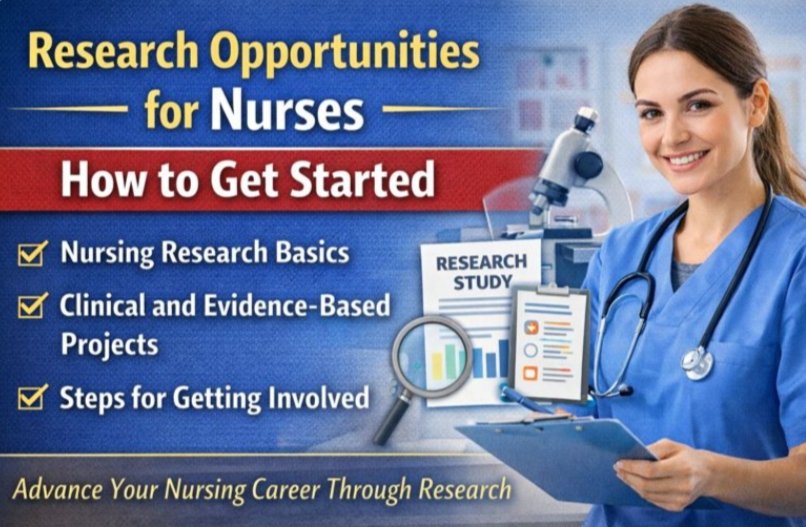
Research Opportunities for Nurses: How to Get Started
Meta Descriptions
Discover research opportunities for nurses and learn how to get started in clinical research, EBP, and quality improvement to advance your nursing career.

Nursing is more than bedside care. It is leadership, advocacy, education — and research.Many nurses assume research is only for PhD holders working in universities. That’s not true. Every nurse, from a new graduate to an experienced ICU specialist, can participate in research and contribute to evidence-based practice.
If you’ve ever wondered:
“How can I get involved in nursing research?”
“Do I need a doctorate to do research?”
“Where do I even start?”
This guide will walk you through everything — in simple, practical language.
Why Nursing Research Matters
Healthcare changes rapidly. New medications, new technologies, and new treatment guidelines appear every year. Without research, nursing practice would remain outdated.
Nursing research helps:
Improve patient outcomes
Reduce medical errors
Develop safer procedures
Strengthen evidence-based practice
Shape healthcare policies
Advance nursing as a profession
Every time you follow a clinical guideline, that recommendation is based on research conducted by healthcare professionals — including nurses.Research is how nursing grows.

Nursing research is the systematic investigation of:
Patient care practices
Nursing interventions
Health education strategies
Patient safety protocols
Healthcare systems
Community health outcomes
It answers questions like:
Does hourly rounding reduce falls?
Which wound dressing promotes faster healing?
How does nurse staffing affect patient outcomes?
What improves medication adherence in elderly patients?
Research transforms daily observations into measurable, publishable knowledge.

Types of Research Nurses Can Participate In
You don’t need to design a large randomized clinical trial to be involved in research. There are many levels.
1. Clinical Research Focuses on patient care in hospital or clinic settings.
Examples:
Evaluating infection prevention strategies
Studying pain management effectiveness
Assessing post-operative recovery outcomes
You can participate by collecting data, assisting investigators, or implementing protocols.
2. Evidence-Based Practice (EBP) Projects
EBP is often the easiest entry point for nurses.Instead of creating new knowledge, EBP applies existing research to improve practice.
Example:
Reviewing literature on catheter-associated UTIs
Implementing updated care bundles
Measuring infection rates before and after
Many hospitals encourage EBP projects — especially for career advancement.
3. Quality Improvement (QI) Projects
QI projects focus on improving processes within a healthcare setting.
Examples:
Reducing medication errors
Improving discharge education compliance
Increasing hand hygiene rates
QI is research-friendly and often does not require extensive ethical approval compared to formal research studies.
4. Academic Research Conducted in universities or nursing schools.
Examples:
Nursing education strategies
Student performance outcomes
Simulation training effectiveness
If you work as a nurse educator or plan to pursue graduate education, academic research may interest you.
5. Community & Public Health Research Focuses on broader populations.
Examples:
Vaccination awareness programs
Maternal health education outcomes
Chronic disease management in rural communities
Community nurses play a major role in this type of research.

Benefits of Getting Involved in Research
Participating in research offers professional and personal advantages:
Career Advancement Research experience strengthens:
Resume Graduate school applications
Promotion eligibility
Leadership opportunities
Increased Professional Confidence
Understanding research improves clinical decision-making.Improved Patient Outcomes
You contribute directly to safer, better care.Academic Growth
Research involvement opens doors to:
MSN
DNP
PhD programs
Clinical nurse specialist roles
Nurse educator positions
Do You Need an Advanced Degree?
No — not to start.

Here’s how education levels relate to research:
ADN / BSN nurses: Participate in data collection, QI projects, EBP initiatives.
MSN nurses: Lead projects, analyze data, write reports.
DNP nurses: Translate research into practice.
PhD nurses: Design and conduct original research studies.You can begin at any level.
Step-by-Step: How to Get Started in Nursing Research
Step 1: Develop a Research Mindset
Start by asking questions in your daily practice:
Why do we do it this way?
Is there evidence supporting this practice?
Can this process be improved?
Curiosity is the foundation of research.
Step 2: Strengthen Your Knowledge.
Base You don’t need to be a statistician, but basic understanding helps.
Learn about:
Research terminology
Study designs
Evidence hierarchy
Data collection basics
Free options:
Online courses
Hospital workshops
Nursing conferences
Research webinars
Step 3: Join Your Hospital’s Research or EBP Committee
Most hospitals have:
Research councils
EBP committees
Quality improvement teams
Ask your nurse manager how to join.This is one of the easiest and most effective ways to get involved.
Step 4: Find a Mentor
A research mentor can guide you through:
Topic selection
Literature reviews
Data analysis
Publication processes
Mentors may be:
Nurse educators
Clinical nurse specialists
DNP-prepared nurses
University faculty members
Mentorship accelerates growth.
Step 5: Start Small You don’t need a massive project.
Begin with:
Chart audits
Policy evaluations
Patient satisfaction surveys
Educational intervention studies
Small projects build confidence and experience.
Step 6: Learn Basic Literature Review Skills
A literature review means searching scholarly databases like:
PubMed
CINAHL
Google Scholar
Look for:
Peer-reviewed articles
Recent publications (last 5 years)
Systematic reviews
Clinical guidelines
Reading research strengthens critical thinking.
Step 7: Understand Ethics & IRB Approval
Some research requires Institutional Review Board (IRB) approval to protect patient rights.You’ll need IRB review if:
You collect identifiable patient data
You plan to publish findings
You conduct experimental studies
Quality improvement projects sometimes do not require full IRB approval
— check institutional policies.Ethics always comes first.
Step 8: Collect and Analyze Data
Data collection methods include:
Surveys
Observation checklists
Electronic health record
audits
Interviews
Focus groups
Basic analysis might involve:
Percentages
Averages
Trend comparisons
Pre- and post-intervention comparisons
Advanced statistics can be learned later.
Step 9: Share Your Findings
Research is incomplete unless shared.You can:
Present at staff meetings
Create posters
Submit to nursing conferences
Publish in nursing journals
Write blog articles summarizing findings
Sharing research strengthens the profession.
Common Barriers Nurses Face
1. Lack of Time Solution: Integrate small projects into daily workflow.
2. Fear of Statistics Solution: Start simple. Many QI projects use basic data.
3. Limited Support Solution: Seek mentors or connect with academic institutions.
4. Imposter Syndrome Remember: Every expert once started as a beginner.Research Roles Nurses Can Pursue As you grow,
you may explore roles such as:
Clinical Research Nurse
Nurse Research Coordinator
Evidence-Based Practice Specialist
Nurse Scientist
Clinical Trials Nurse
Quality Improvement Specialist
Nurse Educator
Research can become a full-time career or remaining a part of clinical practice.

How Research Improves Bedside Nursing
Research involvement helps you:
Interpret new guidelines critically
Understand medication studies
Evaluate new technologies
Advocate for safe staffing
Lead evidence-based changes
Research makes you a stronger clinician.
Research Opportunities by Nursing Specialty
Every specialty has research potential.Critical Care
Ventilator-associated pneumonia prevention
Sedation protocols
Early mobility
program PediatricsVaccination
adherence Parental education effectiveness
Oncology
Chemotherapy side effect management
Pain control protocols
Mental HealthTherapy effectiveness
Medication compliance strategies
Community Health
Health promotion programs
Chronic disease prevention
Research opportunities exist everywhere.Publishing as a Nurse
Publishing may seem intimidating, but it is achievable.
Start with:
Case studies
QI project summaries
Evidence-based reviews
Educational articlesTips:
Follow journal submission guidelines carefully.
Work with co-authors if possible.
Expect revisions — they are normal.
Publication builds credibility and professional recognition.
Continuing Education & Certifications If research truly interests you,
consider:
MSN in Nursing Research
DNP (Doctor of Nursing Practice)
PhD in Nursing
Clinical Research certification
Evidence-Based Practice training
Formal education deepens expertise but is not required to begin.
Research and Leadership
Nurses involved in research often become leaders because they:
Understand dataThink critically
Evaluate outcomes
Support evidence-based decisions
Leadership and research go hand in hand.
How to Build a Research-Friendly Resume
Include:
Committee memberships
QI projects
Poster presentations
Publications
Research assistant roles
Conference attendance
Even small projects count.
The Future of Nursing Research
Healthcare continues to evolve with:
Telehealth
Artificial intelligence
Genomic medicine
Patient-centered care models
Frequently Asked Questions
Can a new graduate nurse do research?
Yes. Start with EBP or QI projects in your workplace.
Is research stressful?
It can be challenging, but mentorship and teamwork reduce stress.
Do I need to be good at math?
Not necessarily. Many projects use basic statistics.
Can I balance bedside nursing and research?
Yes. Many nurses participate part-time.
Final Thoughts:
Start Where You Are You don’t need a doctorate. You don’t need to be a statistics expert. You don’t need to publish immediately.You only need curiosity and a willingness to learn.Research opportunities for nurses are expanding. Whether you work in a hospital, clinic, school, or community, there is space for you to contribute to evidence-based care.The best time to start is now.Ask a question. Join a committee. Read one research article. Volunteer for a small project.One step at a time — you’ll become part of the change that improves patient care worldwide.