
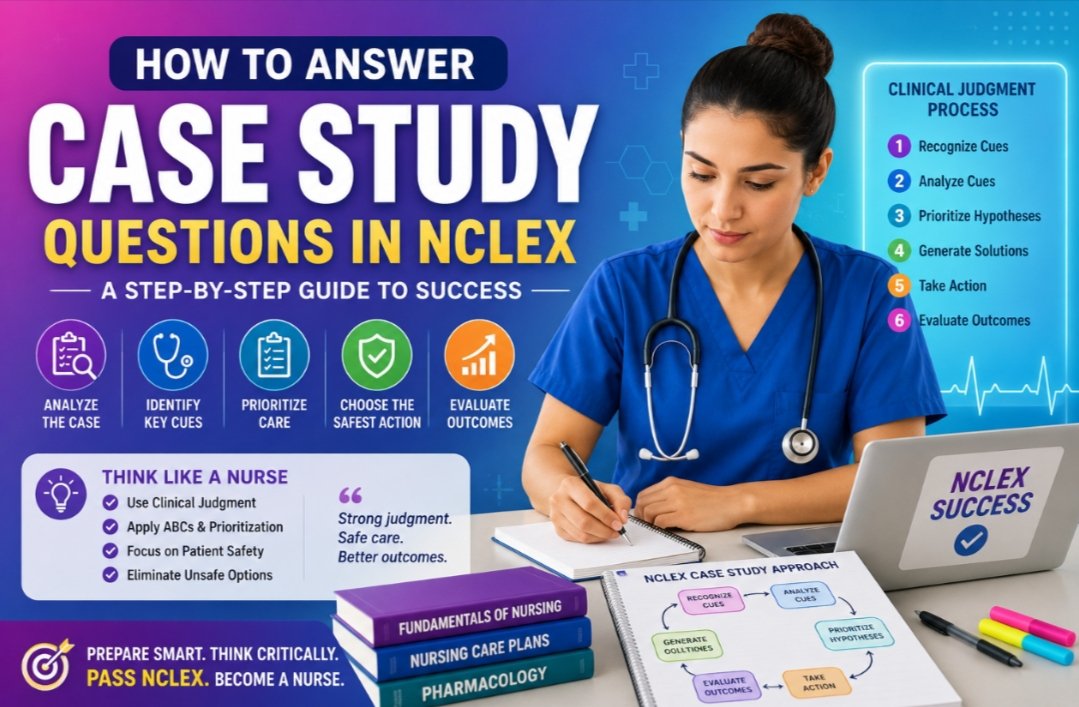
How to Answer Case Study Questions in NCLEX
Meta Description
Learn how to answer NCLEX case study questions with confidence. Discover proven strategies, clinical judgment tips, prioritization methods, and exam techniques to improve your NCLEX success
How to Answer NCLEX Case Study Questions: A Strategic Guide for Nursing Students
The Next Generation NCLEX isn’t testing your ability to memorize drug names or recall normal lab values in isolation. It’s testing something harder and more meaningful: whether you can think like a nurse under pressure. Case study questions are the exam’s primary tool for doing exactly that, and they trip up students not because the content is unfamiliar, but because the approach is.
This guide breaks down how to read, analyze, and answer NGN case study questions with the kind of structured reasoning that translates to real clinical judgment — on the exam and beyond.
What the NGN Is Actually Measuring?
Understanding why case studies exist on the NCLEX matters more than most students realize. The National Council of State Boards of Nursing redesigned the exam around the Clinical Judgment Measurement Model (CJMM) because research showed a gap between what traditional multiple-choice questions tested and what entry-level nurses actually need to do safely.
That model has six cognitive steps: recognize cues, analyze cues, prioritize hypotheses, generate solutions, take action, and evaluate outcomes. Every case study question you encounter maps onto one or more of these steps. When you understand that framework, you stop guessing at what a question is “really asking” — you can identify it directly.
How Case Study Questions Are Structured
Each NGN case study presents a patient scenario — typically including history, assessment findings, vital signs, lab values, medications, and provider orders — followed by a cluster of related questions. The questions aren’t independent. They build on each other, which means a detail buried in the nursing notes at the start of the case may become the hinge point of a question three screens later.
This is the first thing students get wrong: treating each question as its own isolated puzzle. It isn’t. The case is one continuous clinical situation, and your job is to track what’s happening to this patient over time.
The question formats you’ll encounter include:
Multiple response — select all that apply, evaluated answer by answer. There’s no magic number to aim for; treat each option as its own true/false judgment.
Matrix/grid questions — categorize findings as expected or unexpected, relevant or irrelevant. These demand careful, methodical thinking rather than pattern-matching.
Drag-and-drop — sequence nursing actions in the correct order. Assessment almost always precedes intervention; safety precedes comfort.
Cloze (drop-down) — complete a clinical note or care plan by selecting from provided options. Pay close attention to dose calculations and clinical thresholds here.
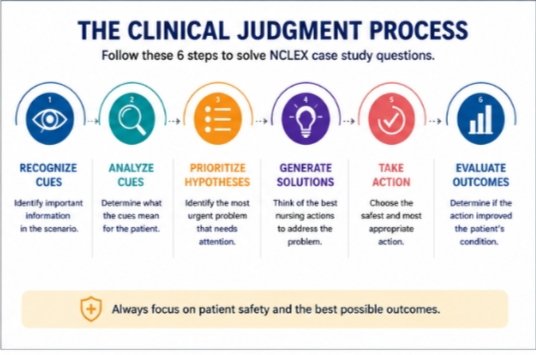
A Systematic Approach to Reading Any Case Study
Read the entire scenario before answering anything. This sounds obvious, but exam anxiety pushes students to jump to the first question immediately. Resist it. Read the full patient presentation once through, noting abnormalities, then return to answer each question with the complete picture in mind.
As you read, actively flag:
Vital sign deviations (not just whether a value is abnormal, but how abnormal and in which direction)
Trends over time — a blood pressure dropping from 118/76 to 94/60 across three sets of vitals tells you more than a single low reading
The patient’s baseline versus current status, especially in older adults or those with chronic conditions
Medications that could explain findings — or worsen them
Any detail that seems oddly specific. The NCLEX does not include irrelevant information by accident.
Ask yourself one orienting question before you touch the first answer option: What is this patient’s most urgent problem right now?
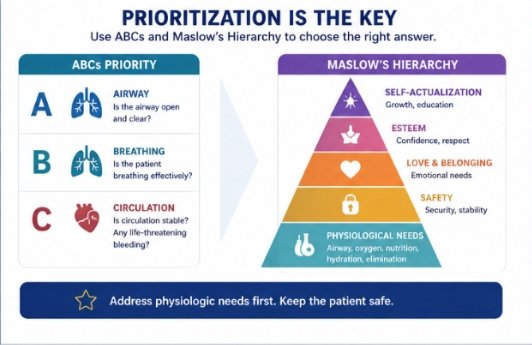
Prioritization: The Heart of NCLEX Reasoning
Most case study questions, regardless of format, are ultimately prioritization questions. They’re asking you to rank competing concerns and defend your clinical reasoning by choosing an action.
Two frameworks anchor NCLEX prioritization:
ABCs — Airway, Breathing, Circulation. When a patient has multiple problems, the one threatening their airway comes first. Always. A patient in respiratory distress and a patient in pain both need attention, but they don’t need it in the same order. If one answer option addresses oxygenation and another addresses comfort or education, the physiologic threat takes precedence.
Maslow’s Hierarchy. Physical survival needs — oxygen, circulation, hydration, nutrition — are addressed before psychological or educational ones. This seems intuitive until you’re staring at a question where a patient is anxious, in pain, and has a falling SpO2, and you have to sequence your interventions.
These aren’t just test-taking tricks. They reflect how practicing nurses actually triage competing demands.
Recognizing What the Question Is Really Asking
NCLEX questions are precise, and specific words carry clinical weight.When a question asks what the nurse should do first, it’s asking you to identify the most time-sensitive action — not the most comprehensive one. When it asks for the priority patient, it wants the most unstable. When it asks what requires immediate intervention, it’s flagging a situation that’s deteriorating now.
Train yourself to pause on these words. They’re not filler. They’re instructions.
Working Through Patient Data Without Getting Overwhelmed
High-stakes case studies sometimes present a dense wall of information — assessment findings, labs, medication lists, provider notes. Students freeze here or, worse, anchor on the first abnormality they find and ignore the rest.
A more effective approach:
Identify the admitting diagnosis. What brought this patient in?
Find the findings that support that diagnosis. What’s expected given the clinical picture?
Find the findings that don’t fit. What’s new, worsening, or out of proportion?
Ask yourself: is this patient stable, declining, or in immediate danger?
That last question is the one the NCLEX is built on. Everything else — the specific intervention, the correct priority, the safest action — flows from an accurate answer to it.
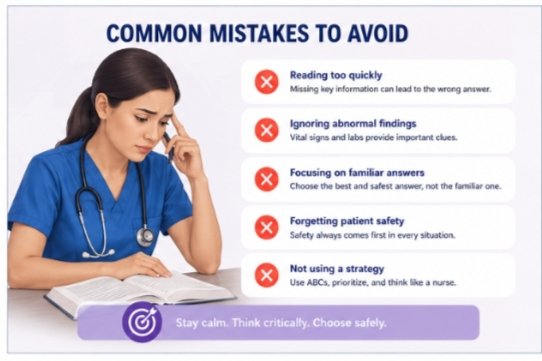
Common Reasoning Errors to Avoid
Choosing the familiar answer over the safe one. If two options both seem plausible, ask which one protects the patient from harm. The NCLEX is, at its core, a safety exam.
Intervening before assessing. Many students choose action-oriented answers because they feel decisive. But in several scenarios, the correct first step is to gather more information — verify a finding, reassess a trend, check before administering. Assessment isn’t passive; it’s often the most clinically appropriate action.
Treating every vital sign reading in isolation. A single abnormal value can be meaningful. Multiple converging abnormalities almost always signal a developing complication. Read the data as a pattern.
Letting answer options do your thinking. Read the question, form your own expectation of the answer, then look at the options. Students who look at options first often get anchored to a plausible-sounding distractor before they’ve reasoned through the clinical picture.
Building the Skills That Actually Transfer
Case study performance on the NCLEX improves with the same habits that build clinical judgment in practice:
Work through question rationales, not just answer keys. Understanding why an answer is correct — and why the others aren’t — builds reasoning patterns that transfer across different scenarios. Getting a question right by instinct without understanding the rationale leaves you no more prepared for the next one.
Study disease processes, not isolated facts. Knowing that sepsis causes vasodilation → decreased SVR → compensatory tachycardia → potential hypotension gives you a framework for recognizing septic patients under a dozen different presentations. Memorizing “tachycardia = bad” doesn’t.
Practice reading lab values in context. A potassium of 3.1 means something different in a patient on digoxin than in a healthy post-op patient. Context determines clinical significance.
Build comfort with ambiguity. Real patients — and NGN cases — rarely present with one clean problem and one obvious answer. Learning to sit with incomplete information and still make a defensible clinical judgment is a skill, and it develops with practice.
On Exam Day
Before answering any question: read the full scenario, identify the primary problem, apply your prioritization framework, and eliminate answers that delay care, ignore safety, or fall outside nursing scope.

Final Thoughts
NCLEX case study questions may seem intimidating at first, but they become much easier when approached systematically.
Success depends on understanding clinical judgment rather than memorizing facts. By recognizing cues, analyzing patient information, prioritizing care, and focusing on patient safety, you can confidently answer even the most complex case study questions.
Remember that the NCLEX is designed to determine whether you can provide safe and effective nursing care. Every question ultimately comes back to one goal: protecting the patient.
Practice consistently, review rationales carefully, strengthen your clinical reasoning skills, and approach each case study with confidence.With preparation and the right strategy, you can master NCLEX case study questions and move one step closer to becoming a licensed nurse.
❓ Frequently Asked Questions (FAQs)
1. What are NCLEX case study questions?
NCLEX case study questions are patient-based scenarios that assess a nursing student’s ability to apply clinical judgment, critical thinking, and decision-making skills in real-life healthcare situations. These questions are a major component of the Next Generation NCLEX (NGN).
2. Why are case study questions important in the NCLEX?
Case study questions evaluate whether nursing candidates can safely care for patients by recognizing symptoms, prioritizing care, making clinical decisions, and evaluating outcomes. They reflect real-world nursing practice.
3. What is the Clinical Judgment Measurement Model (CJMM)?
The Clinical Judgment Measurement Model (CJMM) is the framework used in the Next Generation NCLEX to assess nursing judgment through six steps:Recognize cuesAnalyze cuesPrioritize hypothesesGenerate solutionsTake actionEvaluate outcomes
4. How can I improve my performance on NCLEX case study questions?
You can improve by:Practicing NGN-style questions daily
Learning disease processes
Mastering laboratory values
Understanding prioritization frameworks (ABCs and Maslow’s Hierarchy)Reviewing rationales carefully
5. What is the ABC priority method in NCLEX?
ABC stands for:
A – Airway
B – Breathing
C – Circulation
This method helps nurses determine which patient needs immediate attention and which intervention should be performed first.
6. How do I identify the priority patient in a case study?
Look for signs of instability such as:
Difficulty breathing
Low oxygen saturation
Chest pain
Altered mental status
Severe bleeding
Sudden changes in vital signsThe patient with the most immediate threat to life is usually the priority.
7. Are NCLEX case study questions harder than traditional NCLEX questions?
Many students find them more challenging because they require critical thinking and analysis rather than simple memorization. However, with consistent practice and a structured approach, they become much easier to answer.
8. What common mistakes should I avoid when answering case study questions?
Common mistakes include:
Reading too quickly
Ignoring abnormal findings
Forgetting patient safety principles
Not using prioritization frameworks
Choosing familiar answers instead of the safest answers
9. How important are laboratory values in NCLEX case studies?
Laboratory values are extremely important because they often reveal patient deterioration or complications. Nurses should understand common lab ranges and know how abnormal results affect patient care.
10. What should I do if I am unsure of the correct answer?
If unsure:
Focus on patient safety
Apply the ABC framework
Eliminate clearly incorrect answers
Choose the intervention that prevents the most harmThink like a practicing nurse
11. How many case study questions are included in the Next Generation NCLEX?
The number may vary, but the NGN includes several case-study style questions designed to assess clinical judgment and decision-making skills throughout the exam.
12. Can practicing case studies improve my NCLEX score?
Yes. Regular practice with realistic case studies improves:
Critical thinking
Clinical judgment
Prioritization skills
Confidence
Exam performance
Many successful NCLEX candidates consider case study practice one of the most effective preparation strategies.
13. What is the best way to study for NCLEX case study questions?
The best approach includes:
Practicing NGN question banks
Reviewing nursing fundamentals
Understanding disease processes
Learning prioritization strategies
Studying medication safety
Completing nursing simulations
14. How can nursing students develop stronger clinical judgment?
Clinical judgment improves through:
Clinical experience
Case study practice
Reflection on patient care situations
Reviewing nursing rationales
Participating in simulation training
15. What is the key to success in NCLEX case study questions?
The key is to focus on patient safety, clinical judgment, prioritization, and critical thinking rather than memorizing facts. Successful nurses learn to analyze patient situations and make safe, evidence-based decisions.